
String Theories
A Century Of Jazz Icons; The Acid Trip Of Infinite Jest; Kashus Culpepper's Country Soul; Tennessee Acoustic Albums; The Milk Carton Kids; More!
Hello Friends
I’m sending this out on a “big” birthday, which was pretty much a coincidence of when it was ready. But hey, whatever it means and for what it’s worth, it is a fact that I was born on June 14, 1966, so I’ve achieved sexagenarian status, and since I spelled that word correctly on the first try, I declare myself cognitively fit for the battles ahead. I’m trying to put out of my mind that I share this b-day (20 years later) with a certain criminal-in-chief who’s decided to indulge his imperial selfness with televised gladiatorial cage fighting on the White House lawn with patriotic colors flying for our nation’s 250th birthday. An aching symbol of our nation, at its nadir in my lifetime.
What follows are two essays - one about how a show marking a major jazz-iversary has me so grateful to be an American music fan - and another about the experience of reading one of the 20th century’s most infamously difficult novels. If that sounds like exactly the kind of incisive cultural commentary that sustains you, please read on. If it sounds like the kind of highfalootin’ BS that poisons our youth, then you need to read on. After that are links to WMOT features about: the folk duo The Milk Carton Kids, surprise soul-country breakout Kashus Culpepper, new folk and folk adjacent albums from Tennessee, and what the sad demise of the 12 South Tap Room tells us about where we do and don’t find great music and community.
I wrote much of this on the patio at Drifter’s on a Sunday afternoon, listening to my buddies play world-class bluegrass for a deck-full of happy humans. From this bar and barbecue joint, you look over 5 Points in East Nashville. It’s not just a lovely view; it’s an important one. The East Nashville Skyline (™) is dominated by the shapely building known as Woodland Studio. I can see its silky 1960s typographic sign on the wall from here. Its owners, Gillian Welch and David Rawlings painted the place white with black trim, highlighting its demure architectural flair. Beyond that is the 1939 brick masterpiece that is now East Nashville Magnet School (the fightin’ Grey Eagles!). I see the neon sign of Five Points Pizza, which is in the shape of a pepperoni slice. The audience tipped and clapped, which is all these cats ask but les than they deserve. The whole scene restored my mojo after a work/media/digital overload crisis.
God I love this town.
Read on…
Miles And Trane And Sonny
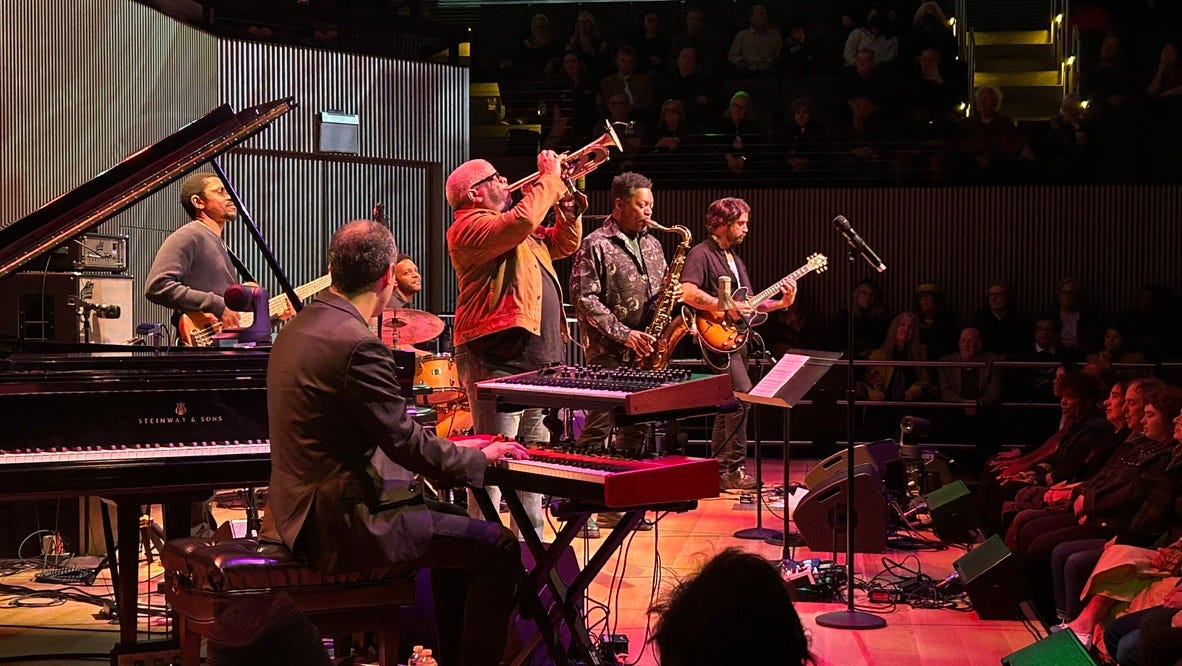
During our recent family vacation in San Francisco, I split off on my own for a show that seemed custom curated for my musical desires - and a nice walk from where we stayed as a bonus. Trumpet player Terrence Blanchard hosted a night marking the 100th birth years of Miles Davis (5.26.26) and John Coltrane (9.23.26) at SFJazz, where he is the executive artistic director. His counterpart for the evening on tenor saxophone was Ravi Coltrane, the 60-year-old son of John and Alice (the extraordinary harpist and composer). This took place just days after the passing of Sonny Rollins, another giant of jazz who was a mere five years younger than Miles or Trane. Same generation of jazz. A triumvirate of American genius hovered in the room.
The band was Blanchard’s E-Collective, featuring Oscar Seaton on drums, David “DJ” Ginyard on bass, Fabian Almazan on piano and keys and Charles Altura on electric guitar. The theater - purpose built for jazz performance in 2013 - is a 750-seater, arranged as perfectly for intimate improvised music as one could imagine. The acoustics were astonishing. I had a seat off stage right, which I secured at the last minute. I felt incredibly lucky to be there, and between the small size of the room and the large stature of the musicians, my anticipation meter was in the red.
So that’s the facts. What about the feelings? I’m a fan, not a jazz critic with massive historical or musicological knowledge, and I don’t think jazz critic-speak is what I aspire to anyway when it comes to conveying the elation and peace that a night like this brings me. I fell into a vortex of sound, of wordless communication, and of rhythm that let me float and feel in a very pure way. Even though I don’t listen to a lot of Terrence Blanchard at home, I was feeling very close to him that night because by coincidence, I’d heard him play just a few weeks before in Pet Metheny’s band at the Ryman Auditorium. I was reminded then how emotionally and technically gifted he is. Original too, with his warm, slightly electronified trumpet sound. He makes meaningful, unexpected gestures large and small, and he sets an atmosphere as a band leader that invites attention and energy.
I heard Ravi Coltrane for the first time that night in San Francisco. He didn’t grow up with his father, who died at age 40 at the height of his career, but he’s been a formidable musician for the past 25 years. Blanchard said, introducing him, that Ravi Coltrane has a voice like nobody else’s, implying how hard that might be for the son of a man with a (literally) sainted sound and legacy. Again, I’m not able to do any kind of analysis of how Ravi fits in the jazz sax world, but it occurred to me that in that concert, he resembled what Sonny Rollins would have looked like and sounded like in his prime.
Sonny Rollins was on all of our minds because he’d passed away just about a week before this concert. And Sonny was the picture of the archetype of the prototypical jazz sax player, with his goatee and sunglasses and 1960s style. But foremost, he was a musical genius who lived up to his cheeky 1956 album title Saxophone Colossus. Maybe what I feel qualified to say is that, with caveats, if Miles defines one pole of a style (minimalist, spare, gestural) and Coltrane defines the other (extravagant, verbose, textural), then Sonny splits the difference. He was a geyser of melodic ideas who could stretch his soliloquy solos to 20 minutes or more in some cases. Without being boring or repetitive. At the same time, he was not self-indulgent or impressed by his own voice. In fact he was almost neurotic about how much better he thought he could be and how much more he wanted to grow.
That evokes one story that everyone should know about Sonny Rollins, because it’s how he went from celebrated artist to myth. After being elevated quickly to superstar status in the 1950s, he abruptly went on hiatus at 29 years old. Then, as recounted in the NYT by Ned Rothenberg:
From the summer of 1959 to the autumn of 1961, he retired from public performance and spent upward of 15 hours a day practicing on the Williamsburg Bridge’s pedestrian walkway.
He made the bridge his musical mountaintop. He was living by then in an apartment he shared with his wife, Lucille, on Grand Street on the Lower East Side, a short walk away. Initially, he made this trek out of consideration for a neighbor who was pregnant and needed her rest. But he found unexpected rewards competing with the roar of the trains rolling by. “It was so wonderful to be so close to the sky up there, any time of year. Maybe this might sound a little bit corny to people, but it was a spiritual feeling to me,” Rollins told The Guardian.
Then, after looking for all the world like another busker, Rollins returned to public life, refreshed for the next chapter of his career. He recorded The Bridge, a classic American album that didn’t offer a revolutionary sound, but a refined take on the unique voice that was Sonny. And I guess what I would like folks to take away from this, and a point I make in my book, is that jazz soloists develop voices as clear and distinct as any singer. The horns they play have the same basic architecture, but the way they touch them - physically, intellectually and spiritually - brings forth profound, rewarding human expression. And we need to feel free to indulge our personal taste in such matters. You’re not supposed to like John Coltrane. In fact I’m not all that nuts about his style and sound. I respect the hell out of him and I understand his influence on generations of players. I’m just more emotionally involved in what came out of Sonny Rollins and my other favorite sax players, Joe Henderson and Wayne Shorter. I encourage you to listen to these legends and today’s masters enough to feel the differences and to know who speaks to you most clearly.
The show itself - Saturday night at one of the greatest jazz showcase rooms in the world, with its top-shelf presentation including wall-sized projections of photos and album covers - left me slack-jawed. I didn’t think about anything else but patterns, tone and groove for more than 90 minutes. Two guys stood out. The keyboard player - Fabian Almazan - and what a name that is - had his back to me, with his synths to his right and his grand piano to his left. Then there was Charles Altura on electric guitar, a new name to me and a stunning musician. I’ll add him to my list of faves on the six-string and seek out his music in the future.
That’s a life chasing jazz and music in general. It’s additive and adaptive and enriching. I’m building a world of sound and history and humanity around me that will only grow until my last birthday. Grateful to be on this adventure.
In The Wake Of Infinite Jest
(adapted from a Facebook post of June 3)
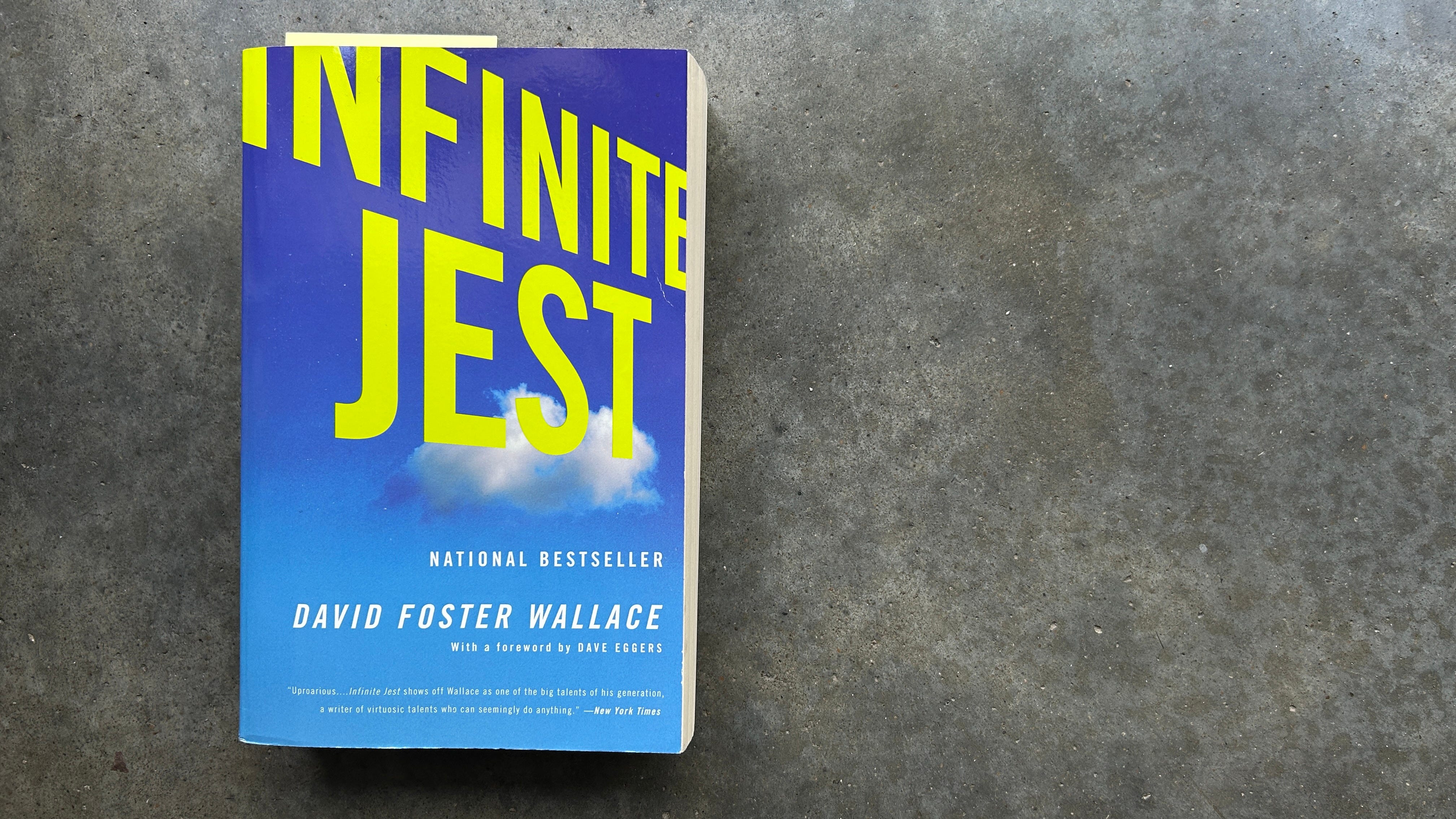
On the flight home from San Francisco, I finished Infinite Jest, the infamously complex and verbose novel by David Foster Wallace. I talked here about getting started on it back in March. It took I guess 10 weeks to read its 1000 pages and endless footnotes. Totally fine. One could say a lot about this book, and many have done just that. Let me throw together some thoughts just for the record. Am I glad I read it? Yes for sure. Am I glad it’s over? Yes. Would I read it again? I feel like I would not want to, but the games and structures in the text and the details that start as a blur and become important are so smart and thrilling that I could see being tempted in the future. I’ll re-read Moby Dick to make that feeling go away.
This wasn’t only a new kind of reading experience but a new experience, like going to a country where you didn’t have an easy time or an easy way home. A literary acid trip in some ways. While there is ultimately a firm, graspable narrative core, nothing is told straight. Three setting/character sets/plotlines weave together, in and out of chronological time. Some scenes grow tiresome with minutia (man can he do details) and you want them to end, but the cumulative effect of Wallace’s word cannons implants a picture of the book’s world and characters that are ultimately more impactful than conventional fiction.
DFW loves words and wordplay, and I love how he does it. He’s my Mozart of prose. I cop stylistic tricks from him all the time. If I hadn’t started this project with a passion for how DFW writes and his sense of the modern world, I don’t think I’d have gotten through the novel. I didn’t always see where he was going, but I trusted his system and enjoyed most of the ride. My big WTF was DFW’s deep concern for and intimacy with bodily fluids and deformity. Things gets uncomfortable, and not an orifice or effusion or bio-process is unexplored as he builds his world full of sometimes grotesque and depraved human beings. There are oceans of sadness and desperation too. But somehow, it leaves one with heart and hope, which is something I asked a lot of questions in my pre-commitment stage. I am not kidding that Chat GPT did a great job of orienting me and assisting me along the book’s emotional trajectory without spoilering it.
It’s a novel fundamentally about addiction and addicts and how the USA of the late 20th century - televised and heavily mediated and medicated America - mirrors the cycles of decline and dopamine that afflict almost every character. What sold me and held me was this meta media story of a country losing its ability to self-govern after generations of mass entertainment. In this, it’s wickedly prescient (published in 1996). The most important object in the novel is a video cartridge with an avant-garde film, called Infinite Jest, made by the main character’s father, and the father, a tragic character who’s most often off-screen or manifested a ghost, had expertise in and an obsession with lenses, a potent metaphor. This film is so compelling and neuro-hacking that its viewers cease to function cognitively. They zone out, piss themselves, and starve while they compulsively play the video on repeat. Nobody knows how to get hold of its master copy, and some people want to copy it for terroristic purposes. That’s all I’ll say. IJ is woven into DFW’s great essays about language, politics, viewership and control, topics that have fascinated me for decades. He’s the greatest modern mind I’ve ever encountered. His greatest novel gave me unprecedented and intimate access to it.
RECENT WORK
Per usual, click on the image/headline to visit the article on the web.


